

When Does Your Period Start? What Counts as Day One

Day one of your period is the first day of real menstrual flow, the kind that needs a pad, tampon, cup or period underwear. Spotting or a brown smear on the toilet paper doesn’t count yet. Your cycle is then counted from that day to the day before the next day one, so getting it right is what makes your cycle length, and any estimate of your next period, make sense.
What counts as day one of your period?
The US Office on Women’s Health puts it simply: your menstrual cycle is counted from the first day of your period up to the first day of your next period. Cleveland Clinic gives the same instruction for tracking. Mark the first day of bleeding as day one, keep marking each day you bleed, and when bleeding starts again, that’s day one again.
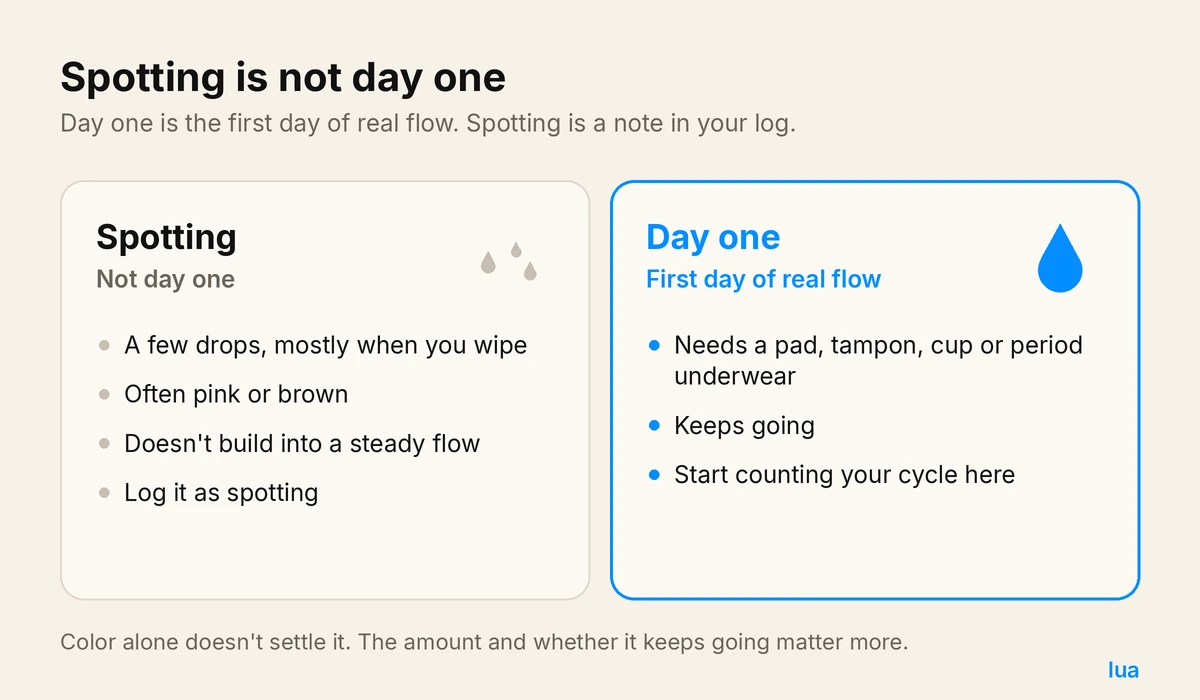
The practical test is flow. If you’d reach for a pad, tampon or cup (more than a liner you wear just in case), and it keeps going, that’s day one.
Does spotting count as day one?
No. Light spotting in the day or two before a period is common, and it usually isn’t the start of the period itself. It’s often pink or brown, shows up when you wipe or as a few drops on a liner, and doesn’t build into a steady flow.
If spotting turns into real flow later the same day, that day is day one. If it turns into real flow the next morning, the next morning is day one, and the spotting day is simply a note in your log. The NHS describes period blood as red when flow is heaviest and pink or brown on lighter days, so color alone doesn’t settle it. The amount and whether it keeps going matter more.
Situation by situation: is it day one?
| Situation | Count as day one? |
|---|---|
| Spotting only (a few drops, mostly when you wipe) | No. Log it as spotting and wait for real flow |
| Brown discharge before your period | No, unless it turns into steady red or dark flow that day |
| Light flow that a liner handles for the whole day | Usually not. Count the first day you need a pad, tampon or cup |
| Flow that needs a pad, tampon or cup | Yes |
| Real flow starts at 11pm | Yes, that calendar day, or the next day if your clinic uses a cutoff. Pick one rule and stick to it |
| Flow starts, stops for a day, then restarts | Yes, the first day of real flow. A short pause doesn’t start a new cycle |
| Bleeding in the placebo or break week of the pill, patch or ring | It’s a withdrawal bleed, not a true period. You can log it, but it doesn’t reflect a natural cycle |
| Breakthrough bleeding on hormonal birth control | No. Log it as bleeding or spotting, not as a new period |
What if your period starts at night or late in the day?
For everyday tracking, the simplest rule is the calendar date. If real flow starts at 11pm on the 4th, the 4th is day one. One day either way won’t wreck an estimate, and the same rule applied every month keeps your numbers comparable.
The exception is if a clinic or doctor gives you their own rule. Fertility clinics often use a cutoff (for example, flow that starts in the late afternoon or evening counts from the next day) so they can schedule tests on the right cycle day. If you’ve been given a rule like that, follow it for that purpose.
What if it’s light, then stops, then starts again?
A period can start light, fade for a day, then get heavier. That’s still one period. Day one is the first day of real flow, and the pause doesn’t reset the count.
Bleeding that comes back a week or two after your period has clearly finished is different. That’s bleeding between periods. A one-off can happen, but if it keeps happening, it’s worth getting checked (more on that below).
Bleeding on the pill, patch or ring
If you use combined hormonal birth control with a break week, the bleed in that week is a withdrawal bleed. Cleveland Clinic explains that it may look and feel like a period but it’s different: it’s triggered by the drop in hormones during the break, and it’s often lighter because the lining doesn’t build up the same way.
So you can log it (it’s useful to know when it came and how long it lasted), but its “cycle length” mostly tells you about your pill pack, not your natural rhythm. Bleeding in the middle of a pack, or when you start a new method like an implant or IUD, is breakthrough bleeding. Log it as bleeding, not as a new day one.
Why day one matters for cycle length
Cycle length is the number of days from one day one to the next day one. It isn’t the number of days you bleed, and it isn’t counted from the end of your period.
Both the Office on Women’s Health and Cleveland Clinic describe a typical cycle as about 28 days on average, with a wide normal range around it (roughly 21 to 38 days depending on the source). Your own number matters more than the average, and it can only be as accurate as the day ones you log.
Here’s how the counting works. Say your logs look like this:
- Real flow starts on March 3. That’s day one.
- Your period lasts five days, so the last bleeding day is March 7.
- On April 1 you notice some brown spotting. Not day one yet.
- Real flow starts on April 2. That’s the next day one.
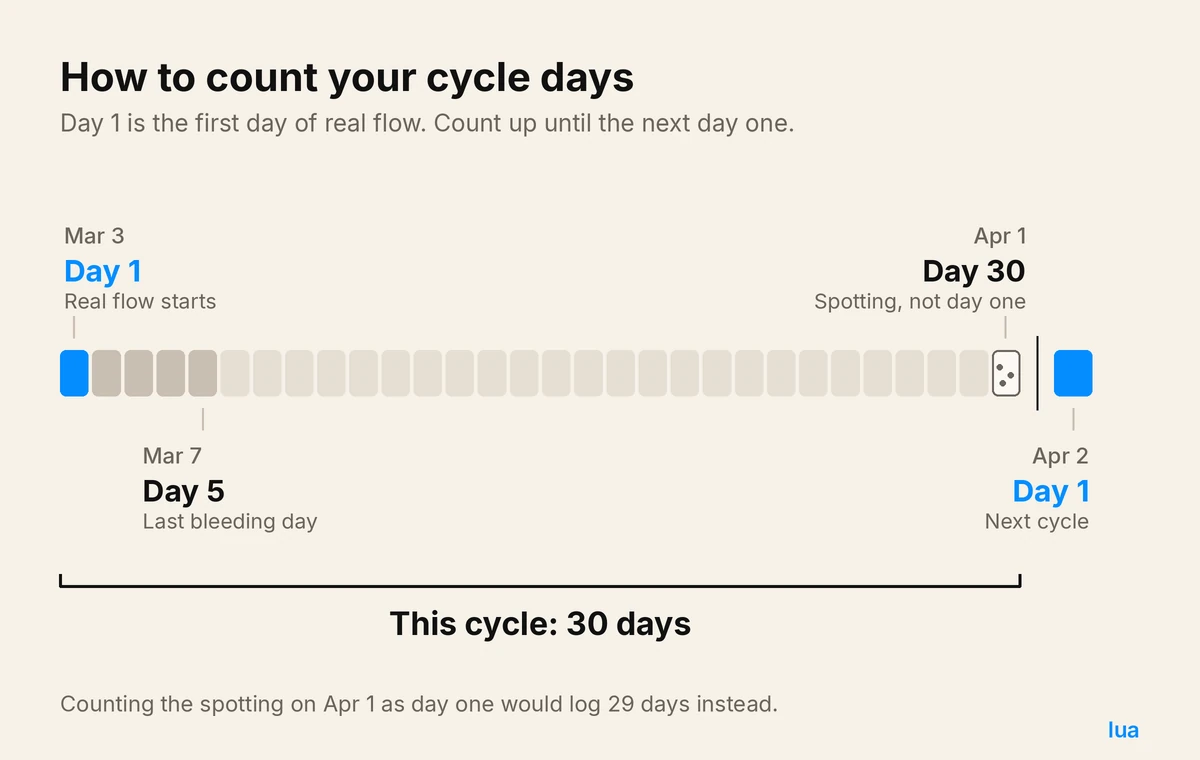
Count March 3 as day 1 and keep going. April 1 is day 30, so that cycle was 30 days long, and April 2 becomes day 1 of the next cycle. If you had counted the spotting on April 1 as day one, you’d have logged a 29-day cycle instead. Mix spotting days and flow days from month to month, and a steady 30-day cycle can look like it jumps between 28 and 32.
Estimates of your next period depend on the same dates. For how a window gets built from past starts, see how to know when your period is coming. If your period feels late, counting from the right day one is the first thing to check, and late period, negative pregnancy test covers what else can be going on. If your cycle lengths move around a lot, tracking irregular cycles explains what a log can and can’t show. Day one also feeds the fertile-window span on an ovulation calendar, which is only as good as the dates underneath it.
When to see a doctor
Most day-one confusion is just about counting. But some bleeding patterns deserve a proper look. See a doctor if you have very heavy bleeding (soaking through a pad or tampon every hour or two, or passing large clots), bleeding between periods that keeps happening, bleeding after sex, or any bleeding after menopause. The NHS says bleeding between periods, after sex or after menopause should be checked. If you might be pregnant and have bleeding with pain, especially sharp pain on one side, get seen quickly.
Log day one and let the app do the counting
When you start with Lua: Period & Birth Control, logging day one is the first thing you do. Mark the first day of real flow, add spotting as its own note, and Lua counts your cycle length for you and estimates when your next period may start. The estimates get better with each cycle you log, and your logs stay on your iPhone.
Sources
- Office on Women’s Health, US Department of Health and Human Services. Your menstrual cycle.
- Cleveland Clinic. Menstrual cycle (normal menstruation).
- Cleveland Clinic. Withdrawal bleeding.
- NHS. Periods.
More from the blog
One app for your cycle, contraception, fertility and pregnancy.
Private, flexible and designed to adapt with you.