

Late period, negative pregnancy test: what it can mean

A late period and a negative pregnancy test can sit together without handing you a single answer. People search that pair because the calendar says bleeding should have started, the stick says not pregnant, and neither feels like enough. The short version: a negative result can be true, early, or mistimed for the cycle you actually have. It rules in less than it feels like it should.
That is the problem on the first screen. The rest is how timing, cycle length, and ordinary life stress make “late” and “not pregnant” share a week.
A missed period and a negative test can still sit together
Home pregnancy tests look for hCG in urine. That hormone rises after implantation, not the morning after sex, and not on a fixed day that matches every calendar. If you test before there is enough hCG to detect, the strip can read negative even if a later test would not.
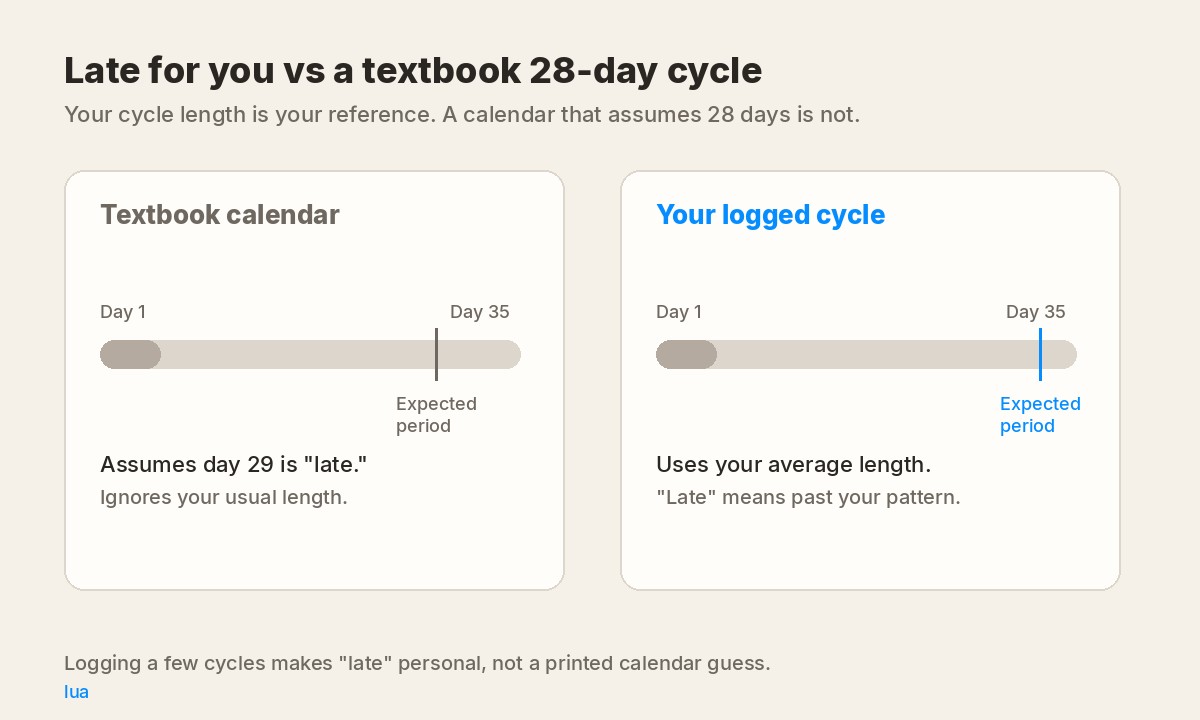
“Late” often means later than the average cycle you keep in your head, not later than a lab schedule. If your usual stretch between bleeds is closer to 32 or 35 days than 28, day 30 is not late for you. It only feels late if you were counting someone else’s rhythm. For how estimates of “when is my period coming” actually work from logged history, see how to know when your period is coming.
Test too early relative to ovulation (not relative to the last bleed alone) and you get a familiar mismatch: missed period on the wall calendar, negative test in the bathroom. Retesting a few days later is a common next step when the first test was early. That is timing, not a verdict about your body.
First-morning urine is often denser. A dilute afternoon sample can make a faint line harder to see. Product instructions matter more than internet day-counting charts. A negative result answers the question the test was built for on that sample, at that moment. It does not rewrite your cycle length.
Why is my period late if the test says not pregnant
Plenty of non-pregnancy reasons stretch a cycle. Stress, a bad week of sleep, a fever, travel across time zones, a sharp change in training, or a noticeable shift in weight can delay ovulation. When ovulation moves, the bleed that follows it moves too. The period is “late” because the earlier event was late.
Cycle length is not a fixed personality trait. It varies. A run of similar cycles makes “on time” feel obvious. A jumpy history makes the same date feel like a cliff. Irregular cycles and what tracking can show is the longer read if your lengths already bounce.
Hormonal birth control also reshapes bleeding patterns. Starting, stopping, skipping placebos, or switching methods can leave a gap that looks like a late period even when a test is negative. That is a light note, not a full “after you quit the pill” guide. The useful takeaway is the same: the calendar on the wall is not always the calendar your hormones are on.
Anovulatory cycles (a cycle without ovulation) happen. Bleeding can arrive late, early, or differently than you expect. You cannot diagnose that from one late week and one stick. You can notice that “late” keeps showing up and bring a clearer history to a clinician if you want one.
None of those explanations are a diagnosis from a blog post. They are the ordinary list people mean when they say late period, not pregnant, and still waiting.
What you notice versus what may be going on
| What you notice | What it may reflect | What logging helps show |
|---|---|---|
| Bleed is a few days past your usual day | Longer cycle than the 28-day habit, or ovulation later this month | Whether “late” matches your own average, not a generic calendar |
| Negative test on the day you expected your period | Test taken before hCG is high enough, or a true negative | The gap between last bleed, estimated fertile days, and test date |
| Negative test, still no bleed a week later | Delayed ovulation, stress or illness stretch, or another non-pregnancy cause | How often this pattern repeats across months |
| Cycle length jumps around | Irregular rhythm, not one broken week | The range of your last several cycles, not a single missed date |
| You feel “late” every month | Expectation set to a shorter cycle than you usually have | The difference between felt lateness and logged lateness |
The table is a map of questions, not a diagnosis grid. Logging does not invent a pregnancy answer. It makes “late for me” visible instead of “late for a textbook 28.”
When to retest, and when to talk to someone
If the first test was early relative to when you think you ovulated, waiting a few days and testing again is common advice on the box itself. Follow the product’s timing. If bleeds keep skipping, pain is severe, you have other symptoms that worry you, or you want care for contraception or trying to conceive, a clinician is the right next step. An app log is a history you can bring. It is not a substitute for that visit.
Skip the panic spiral that turns one late week into an emergency room story. Skip the opposite trap too: treating one negative stick as a permanent all-clear for every future question. Narrow question, honest sample, then decide whether to retest or ask a person who can examine you.
What cycle logging clarifies (and what it does not)
A quiet log of bleed start and end dates answers a smaller question than “am I pregnant?” It answers: for my last several cycles, what does on-time actually look like? When people search late period not pregnant, part of the pain is comparing themselves to a round number. Your own stretch between periods is better evidence of lateness than a wall calendar printed for someone else.
An ovulation calendar can sketch a fertile-window span from those logs. That span is still an estimate. It does not confirm ovulation day, and it does not replace a pregnancy test. Keep the layers separate. Layer one: the stick. Layer two: the dates you typed. Mixing them is how an app starts to feel like a pregnancy answer it cannot give.
Logging also shows patterns over months. One late cycle is noise. A year of widening gaps is a different conversation. You decide whether that conversation is with yourself, a partner, or a clinician. The log’s job is to make the pattern readable.
A quieter place to keep the dates
If you want those bleed dates in one private place on your phone, Lua: Period & Birth Control keeps a quiet on-device log for periods and related notes. Free covers the everyday record. Lua+ is optional, for fuller stats if you want them later, not a wall in front of basic logging. Soft CTA only: cycle logging so “late” means late for your pattern. Not a pregnancy answer, and not a substitute for a test or a clinician when you need one.
More from the blog
One app for your cycle, contraception, fertility and pregnancy.
Private, flexible and designed to adapt with you.