

What an ovulation calendar actually shows
The highlighted days on an ovulation calendar are a span estimated from logged cycle history, not a sensor that knows the ovulation morning. People search “ovulation calendar” (and the same intent as “calendario de ovulación”) because they want a date. What the highlight actually is: a window, not a date. The calendar draws a cluster of days from cycles you have already logged. It is not reading a hormone and not announcing that ovulation will happen at dawn on Thursday.
A highlight is a span, not a verdict
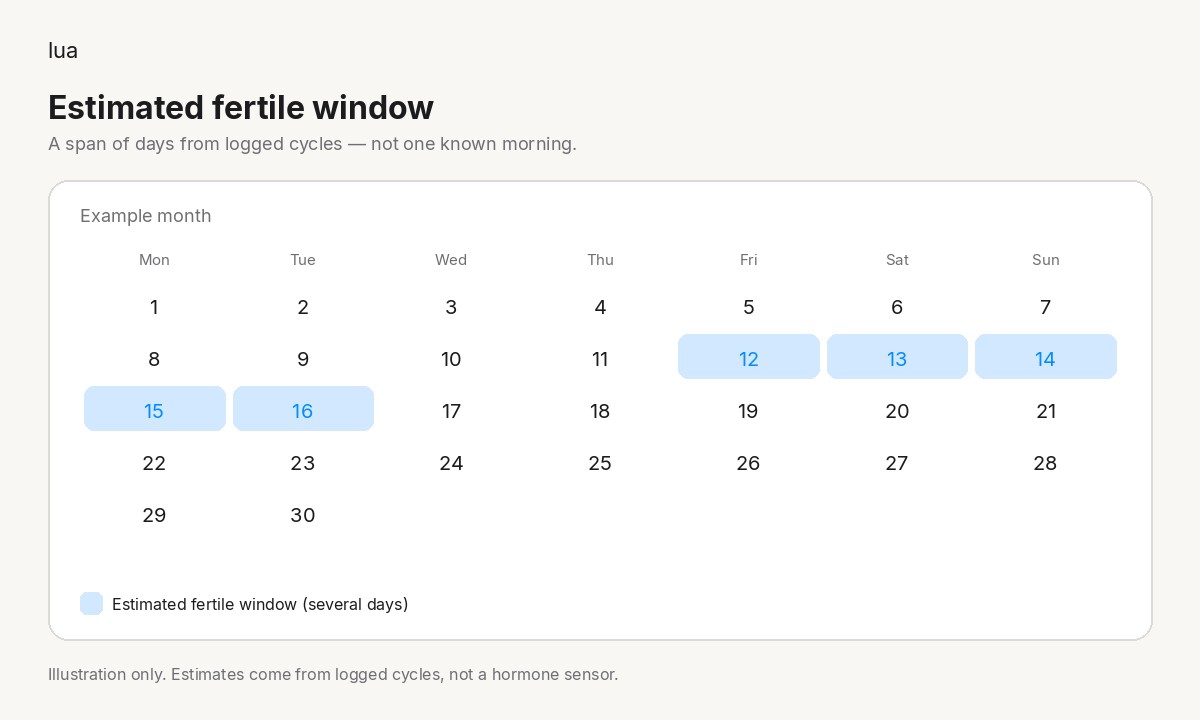
An ovulation calendar takes the period dates you have recorded and, from the length and rhythm of those cycles, estimates a fertile window. That window is the highlight: a band of days, not a pinpoint.
The estimate exists because ovulation is not a public event. You do not feel a timestamp land. A calendar cannot invent one from a grid. What it can do is look backward at how long your last cycles ran, where bleeding started, how steady or uneven that pattern was, and sketch a range. The sketch is useful. It is still a sketch.
Treat the color on the month view as “these days are the estimated window,” not “this is the morning it happens.” If the highlight covers several days, that is not a defect. A window looks like a window. A single glowing cell would be less honest.
What the calendar is actually using
| What people expect | What the calendar actually shows | Why |
|---|---|---|
| One ovulation day | A band of highlighted days | Period logs estimate a window, not an hour |
| A sensor reading | A pattern from past cycles | No hormone data lives in a period log |
| The same date every month | A span that can shift when you log more | Cycle length varies |
| A contraceptive schedule | An estimate only | Lua is not a contraceptive |
Logged cycles. That is the input: start dates, end dates, the stretch between bleeds, sometimes notes you added. Nothing in that log is a lab result, and nothing in the highlight becomes one.
If your cycles have been similar in length, the estimate has more to stand on. If they have jumped around, the window may widen, shift, or look less settled from month to month. That movement is not the calendar failing. It is the calendar admitting that the history is uneven.
The calendar does not know ovulation day. It never will from period logs alone. Ovulation is a hormonal event. A period calendar infers a neighborhood around that event from timing. Neighborhood is the right word. Street address is not.
You can read more about what a fertile window estimate is if you want the idea without the grid. The calendar is that idea drawn onto dates.
Why a window is the honest shape
The days around ovulation are discussed as a span because the event itself is brief and the lead-up is not. Sperm can survive for several days under favorable conditions; the egg’s viability after release is short. Put those together and the practical fertile window is a stretch of days around ovulation, not a single morning. A calendar that marked only one cell would pretend to precision the logs do not contain. The highlight runs longer than the event because the estimate is of a window, not of an hour.
That is why “window, not a date” is not a hedge. It is the thing being shown. If you have been counting toward a specific cell, you are asking for a stamp the logs cannot issue. The smaller question is the true one: given what I have logged, where is the estimated span this cycle?
What it does not show
It does not confirm that ovulation occurred. It does not tell you the hour. It does not replace a conversation with a clinician if something in your cycles worries you. A neat band can still be an estimate. An irregular history can still produce a highlight on thinner ground.
It does not become a prediction of pregnancy, a diagnosis, or a substitute for tests you have not taken. This job is narrower: show a span inferred from logs.
It also does not become a contraceptive plan. Colored days are not a method of avoiding pregnancy, and they are not a schedule for conception. They are an estimate of where a fertile window may sit, drawn from history. Treating the highlight as a green light or a red light for sex asks the display to do a job it was not built to do.
How the estimate moves when you log more
The first month you open a calendar, the highlight is working with very little. A few logged periods later, the pattern, if there is one, has more room to show itself. That does not mean the calendar has become a sensor. It means the estimate has more of your own history to borrow from.
Cycle length is not a fixed trait. Stress, travel, illness, a missed log, a start date entered a week late: all of that can shift the picture. If a highlight jumps, look at what you actually entered before you assume the body did something new. Logging is what the estimate stands on. Gaps show up as wobble in the highlight.
If you want the mechanics of how a span is derived from dates, how to calculate a fertile window walks through that without turning the calendar into something it is not.
Reading the month view without over-reading it
Open the calendar. Find the highlighted days. Read them as a cluster.
Ask whether this cluster is based on cycles you actually logged, or on a thin start. One period makes a first draft. A longer run of similar cycles makes a more settled draft. Still a draft.
Ask whether you logged the last bleed on the day it started, or reconstructed it later. Reconstructed dates are still useful. They are easier to get slightly wrong, and the highlight will follow the error as faithfully as it follows the truth.
Keep the two layers separate. Layer one: your logs. Layer two: a window painted from those logs. Mixing them up is how a calendar starts to feel like a sensor, and a quiet tool like a verdict.
You do not need a more dramatic highlight. You need a clear one: the estimated fertile window from the cycles you logged. Not: we know.
A quieter place to keep the log
If you want those dates in one private place, Lua: Period & Birth Control keeps a quiet on-device log for periods and related notes. Free covers the everyday record. Lua+ is optional, for fuller stats if you want them later, not a wall in front of basic logging. Lua is not a contraceptive. It has no contraceptive effect. Cycle estimates cannot prevent pregnancy, and they cannot know the ovulation morning either. What they can do is stay honest as estimates drawn from the history you entered, so the highlight remains a window, not a claim that someone measured the day.
More from the blog
One app for your cycle, contraception, fertility and pregnancy.
Private, flexible and designed to adapt with you.