

When Is Your Period Over? What Counts as the Last Day

The last day of your period is the last day you bleed. Light brown at the end is usually older blood. Cleveland Clinic says period blood darkens the longer it sits, because it oxidizes, and the last days are typically the darkest. The NHS says blood is red on the heaviest days and may be pink or brown on lighter days.
Spotting days after the flow has stopped is the gray area. A little brown a day or two later can still be leftover period blood (Cleveland Clinic). Bleeding that returns after a clear stop is bleeding between periods, which the NHS says needs to be checked by a doctor.
What a typical period looks like day by day
Flow often starts heavier and then tapers. The NHS says a period can last between 2 and 7 days, usually about 5, and that bleeding tends to be heaviest in the first 2 days. ACOG’s page on heavy and abnormal periods, written for teens, says a typical period lasts 2 to 7 days, with the heaviest bleeding in the first 3 days. There is no single day when every period gets lighter.
The chart below is one example. Day 1 is medium, days 2 and 3 are heavy, day 4 is medium, day 5 is light, and day 6 is light brown. Day 6 is the last day of that period, because it is the last day with blood. Day 7 has no blood, so the period is over. A real period can peak sooner, end sooner, or skip the brown day.
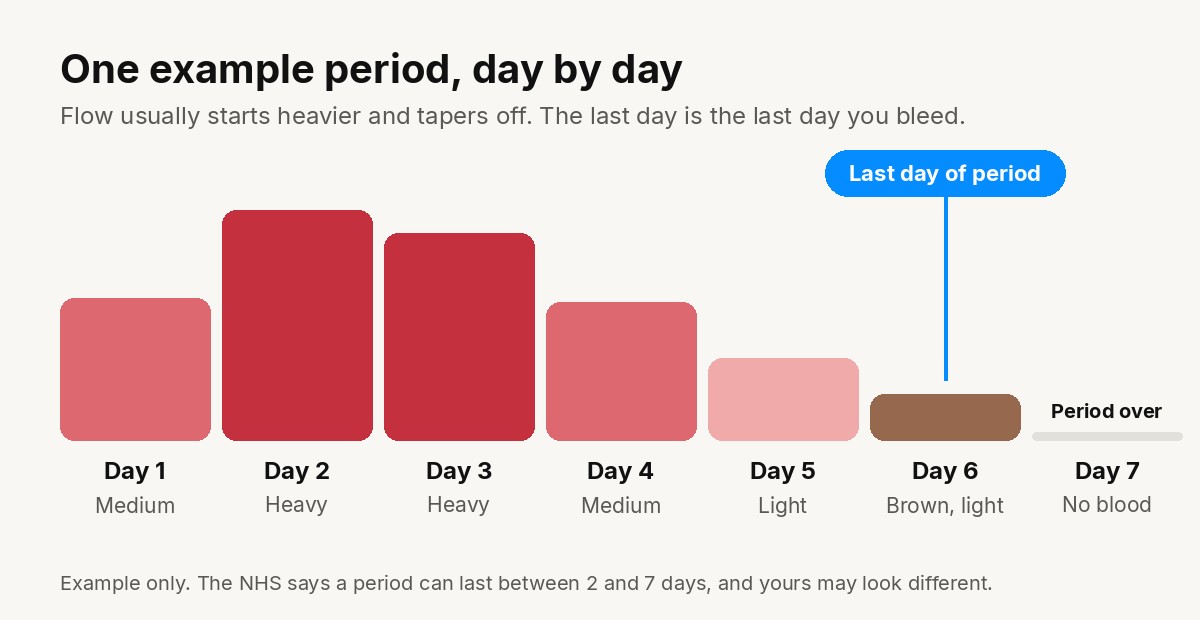
This is one example. The NHS says a period can last between 2 and 7 days, and yours may look different.
Brown blood at the end
Cleveland Clinic’s Ob/Gyn Swapna Kollikonda says the color of period blood depends on how long it stays in the uterus and vagina: “The longer it sits, the darker it gets.” Blood oxidizes, so darker blood is older. The last days are typically the darkest. Brown blood then is common, as the uterus and vagina pass the last of it, and it may mix with vaginal discharge and look dark brown.
Planned Parenthood says menstrual fluid varies in color from dark red to brown or pink. The NHS says lighter days may be pink or brown.
Cleveland Clinic’s Ob/Gyn Oluwatosin Goje says normal brown discharge happens at the end of the menstrual cycle. Leftover blood is often broken down so it does not come out. Sometimes it does come out, toward the end of the period or a day or two after the period has finished. Mixed with vaginal fluid, it looks brown.
Kollikonda says ob-gyns are rarely concerned about the different colors of period blood. Spotting between periods, bleeding after menopause, a heavy flow, or a lighter flow are what they want to look into. Brown before a period starts is a different timing, covered in brown discharge before your period.
Spotting after the period
Sources do not set an official time, or a day of the month, when a period is over. It is over when the bleeding stops.
Planned Parenthood of Greater Texas describes spotting as a small amount of blood, often visible only when you wipe, and usually a lighter color. It can happen between periods, when you were not expecting bleeding. If you need a pad or tampon for a flow that goes on for a few days, that source says it is likely a period.
| What you see at the end of a period | Does it count? | Why |
|---|---|---|
| Light red or pink bleeding while the flow is tapering | Yes, if it is the last day you see blood | It is still bleeding. The NHS says lighter days may be pink or brown. |
| Light brown blood at the end of the flow | Yes | Cleveland Clinic: the last days are typically the darkest, because the blood is older. |
| Brown discharge a day or two after the flow finishes | Count that day. It can be the last day you mark | Cleveland Clinic: leftover blood can appear a day or two after the period has finished, and that can be normal. Mark each day you bleed. |
| Bleeding or spotting that starts again after the period has stopped | No. It does not move the last day | The NHS says bleeding between periods needs to be checked by a doctor. ACOG lists bleeding or spotting between periods as abnormal uterine bleeding. |
Does spotting count as the last day? Only when it is the tail of the same bleed, including a day or two of brown after the heavier flow. The last of those days is the last day. Spotting that starts again after the bleeding has stopped does not extend the period.
Bleeding in the break week of the combined pill, patch or ring is a different pattern, covered in withdrawal bleed vs period.
How long a period lasts
Sources give a range, not one normal length.
| Source | How long bleeding lasts |
|---|---|
| NHS | Between 2 and 7 days, usually about 5 days |
| Cleveland Clinic | Between 3 and 7 days. Most people bleed for 3 to 5 days, and a period of 3 to 7 days is usually not a cause for worry |
| ACOG | Generally up to 7 days. The page for teens says a typical period lasts 2 to 7 days |
| Planned Parenthood | Anywhere from 2 to 7 days |
The Office on Women’s Health does not give one normal length on its menstrual cycle page. It lists bleeding that often lasts longer than 8 days as a sign of heavy bleeding.
A period of 2 days sits inside the NHS and Planned Parenthood ranges. Cleveland Clinic’s range starts at 3 days. The example chart, with blood through day 6, sits inside all of them. Your own usual length, and any change from it, matters more than the average.
Why counting the last day matters
Period length. Period length is the number of days you bleed, from day one through the last day. Cleveland Clinic’s way of tracking is to mark the first day of bleeding, keep marking each day you bleed, stop when the bleeding stops, and count the marks. Leave off the brown tail and the period looks shorter than it was. Pull in a spot from the next week and it looks longer.
Cycle length is a different count. It runs from one day one to the next day one, not from the end of the bleeding. What counts as day one of your period covers the start. How to know when your period is coming is about estimating the next start from past starts. A start that lands a couple of days after you expected is the question in my period is 2 days late.
Spotting between periods. A clear last day makes a later spot show up as its own event. If every spot gets pulled into the period, the log hides bleeding between periods. The NHS says that pattern needs to be checked, and ACOG lists it as abnormal uterine bleeding. When the gaps themselves jump around, tracking irregular cycles is about what those dates can and cannot show.
Noticing a change. Say a period used to end on day 5 and now reaches day 8. That is a change in length, and you only see it if each period has an end date. The NHS says periods can change, for example they may last longer or get lighter, and that a change needs to be investigated. Cleveland Clinic says to contact a healthcare provider if you suddenly bleed for more days than usual.
When it is worth talking to a GP or clinician
Talk to a GP or another clinician if any of these fit:
- The period lasts longer than 7 days. The NHS lists periods lasting more than 7 days as one sign of heavy periods. ACOG calls bleeding that lasts more than 7 days abnormal uterine bleeding. Cleveland Clinic lists period bleeding longer than 7 days as irregular. Planned Parenthood says to make contact if a period lasts much longer than usual, or longer than 7 days.
- The bleeding is very heavy. The NHS includes changing a pad or tampon every 1 to 2 hours, emptying a menstrual cup more often than recommended, and clots larger than about 2.5 cm (about a 10p coin). ACOG includes soaking through one or more tampons or pads every hour. Cleveland Clinic includes soaking through a pad or tampon every hour for at least two hours, and clots that are quarter-sized or larger. Planned Parenthood says to call your doctor, or a Planned Parenthood health center, if you have to change maxi pads or super tampons every hour.
- You bleed between periods. The NHS says this needs to be checked by a doctor. ACOG lists bleeding or spotting between periods as abnormal uterine bleeding. Cleveland Clinic and Planned Parenthood both list it as a reason to make contact.
- The pattern changes suddenly. The NHS says a change, such as periods that last longer or get lighter, needs to be investigated, even though it does not necessarily mean something is wrong. Cleveland Clinic says to make contact if you suddenly bleed for more days than usual, or if the bleeding is much lighter or much heavier than usual. Planned Parenthood includes periods that stop, or that suddenly become irregular.
The NHS also says bleeding after sex, or any bleeding after menopause, needs to be checked by a doctor. ACOG lists both as abnormal uterine bleeding.
ACOG says to seek emergency care right away if you are changing pads or tampons every hour for more than 2 hours in a row and you also have chest pain, shortness of breath, and feel lightheaded or dizzy.
Tracking the last day
A calendar is enough. Cleveland Clinic’s method is:
- Mark the first day of bleeding. That is day one.
- Mark each day you bleed.
- Stop when the bleeding stops.
- Count the marks. That number is how many days the bleeding lasted.
The last mark is the last day. Brown blood on the last days is still period blood, so a light brown day at the tail gets a mark too. If blood shows up again after a gap, mark those days on their own and leave the last day where the bleeding stopped.
The Office on Women’s Health suggests comparing that length with the month before: was the period shorter or longer, and how heavy were the heaviest days? ACOG suggests recording the dates, the length, and whether the bleeding was light, medium, heavy, or spotting.
How Lua fits in
Lua: Period & Birth Control lets you log each bleeding day on your iPhone with no account, and estimates period length and next period from your logged cycles.
Sources
- NHS. Periods.
- NHS. Heavy periods.
- Cleveland Clinic. Period blood comes in different colors: here’s what they mean.
- Cleveland Clinic. Brown discharge: 4 causes and what it means.
- Cleveland Clinic. Menstrual cycle.
- Office on Women’s Health, US Department of Health and Human Services. Your menstrual cycle.
- ACOG. Abnormal uterine bleeding.
- ACOG. Heavy and abnormal periods.
- Planned Parenthood. How do I know if my menstrual cycle is normal?.
- Planned Parenthood of Greater Texas. What’s the difference between spotting and a period?.
More from the blog
One app for your cycle, contraception, fertility and pregnancy.
Private, flexible and designed to adapt with you.