

My Period Is 2 Days Late. Could I Be Pregnant?

If your period is 2 days late, pregnancy is possible if you’ve had sex that could lead to it, but two days on its own doesn’t mean much. Most people’s cycles vary a little from month to month, and Cleveland Clinic’s advice is not to panic over a day or two. A home pregnancy test can work from the first day of a missed period, though it gets more reliable if you wait a few more days.
This post is for the days before you test, or before you’ve decided whether to. If you’ve already tested and got a negative, late period, negative pregnancy test picks up from there.
Is 2 days late normal?
Often, yes. Cleveland Clinic says the average cycle is about 28 days, but anywhere from 21 to 35 days can be normal, and a 28-day cycle one month followed by a 26-day cycle the next is probably nothing to worry about. The US Office on Women’s Health makes the same point from the other side: some people can predict their period to the day, while others who are still regular can only predict it within a few days.
So “late” depends on what’s normal for you. Cleveland Clinic suggests a period might be considered late if it’s been more than 35 days since your last one, or if you’re usually very regular and it’s more than three days late. By that measure, two days late is still inside ordinary variation for a lot of people.
Two quick checks before you count yourself as late:
- Are you counting from the right day? Your cycle runs from the first day of real flow to the first day of the next one. If you counted from a spotting day last month, you may be a day or two off. See what counts as day one of your period.
- Are you comparing against your own cycle or against 28? If your cycles usually run 30 or 31 days, day 30 isn’t late for you.
Could I be pregnant?
If you had unprotected sex this cycle (or your contraception may have failed), yes, it’s possible. A missed period is often the first sign of pregnancy, as Cleveland Clinic notes. The NHS also reminds people that no method of contraception is completely effective, so a test makes sense whenever you think you might be pregnant.
What two days late can’t do is answer the question by itself. For that you need a test at the right time.
Other reasons your period might be a little late
The NHS lists several common causes of a late or missed period besides pregnancy:
- stress
- sudden weight loss, or being overweight
- doing too much exercise
- some hormonal contraception, such as the pill, the contraceptive injection or a hormonal IUS
- breastfeeding
- the start of perimenopause, usually between 45 and 55
- polyendocrine metabolic ovarian syndrome (PMOS), which used to be called polycystic ovary syndrome (PCOS)
The NHS adds that sometimes the gap between periods simply varies each time. On stress, Cleveland Clinic’s view is that minor everyday stress usually won’t affect your period, but major stress (a bereavement, exams, job loss, a wedding or divorce) can make it late.
Timing plays a part too. Mayo Clinic points out that ovulation timing can change from month to month, and that irregular cycles make it hard to know when a period should start.
When is a pregnancy test most reliable?
The NHS says most tests can be used from the first day of a missed period, and that’s when they’re most reliable. Some very sensitive tests claim to work earlier. If you don’t know when your period is due, the NHS suggests testing at least 21 days after you last had unprotected sex.
Waiting a little longer helps. Mayo Clinic explains that tests are more likely to be accurate after the first day of a missed period, because the pregnancy hormone hCG roughly doubles every 2 to 3 days in early pregnancy. Mayo also suggests using your first pee of the morning, when urine is most concentrated, and always following the timing on the test instructions.
Put simply, being 2 days late is often still normal, and a test result gets easier to trust with each day you wait after your period was due.
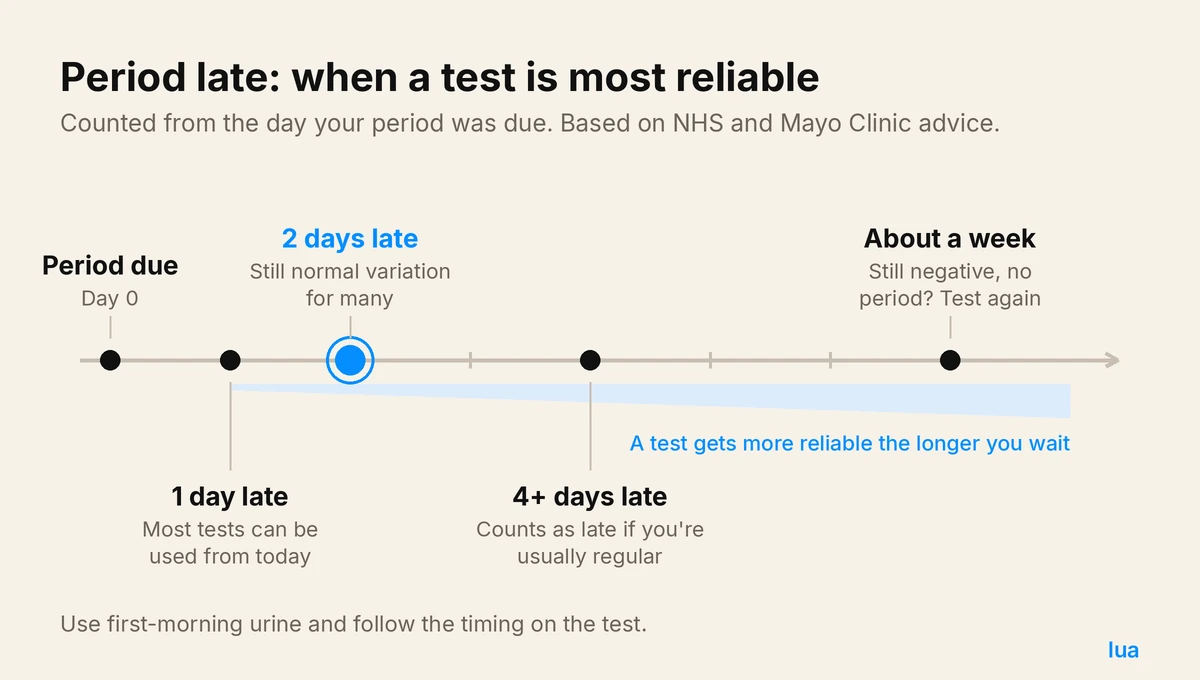
A few things worth knowing:
- A positive result is almost certainly correct, according to the NHS. A negative one is less reliable, mostly because of testing too early.
- If you get a negative and still think you might be pregnant, the NHS says to wait a few days and test again. Mayo suggests testing again about a week after your missed period.
- Hormones in the pill won’t stop a pregnancy test working (NHS).
What to do today vs in a few days
| Days late | What makes sense |
|---|---|
| 1 to 3 days | Check your day one and your usual cycle length. If pregnancy is possible, you can test now, but a negative this early is less reliable |
| 4 to 6 days | If you’re usually regular, this now counts as late. Take a test, ideally with first-morning urine. If it’s negative and your period still hasn’t come, test again in a few days |
| About a week | If earlier tests were negative and there’s still no period, test again. Mayo Clinic suggests this as a good point to retest |
| Negative on a second test, still no period | See a GP or nurse, as the NHS advises. Our post on a late period with a negative test covers what else could be going on |
| Periods coming less often than every 38 days, or 3 missed in a row | See a doctor, even if tests are negative |
If you’re trying to conceive and wondering about the odds in general, our pregnancy chances calculator shows how average per-cycle chances add up over several cycles. It’s an educational model, so it can’t tell you whether you’re pregnant this month.
When to see a doctor
Most late periods are nothing serious. Get checked if:
- you’ve had a negative test twice and your period still hasn’t arrived (NHS)
- you’ve missed your period three times in a row (NHS)
- your periods have become irregular, or you’ve missed a period along with other changes like weight gain or loss, tiredness, new facial hair, or dry or oily skin (NHS)
- you bleed through one or more pads or tampons every one to two hours, or pass clots larger than a quarter (Office on Women’s Health)
Get help quickly if you might be pregnant and have pain low down on one side of your tummy, vaginal bleeding or brown watery discharge, or pain in the tip of your shoulder. The NHS says to contact a doctor or urgent care line right away in that case, even if you haven’t had a positive test, because it can be a sign of an ectopic pregnancy. Sudden, severe tummy pain with dizziness or fainting is an emergency.
See whether you’re late for you
Late only means something against your own pattern. Lua: Period & Birth Control estimates your next period from the cycles you’ve logged, so you can see whether you’re actually late for you rather than against a textbook 28 days. It can’t tell you whether you’re pregnant (that’s what a test is for), but it keeps your dates straight so you know when a test makes sense.
Sources
- Cleveland Clinic. 8 reasons why your period is late.
- Office on Women’s Health, US Department of Health and Human Services. Your menstrual cycle.
- Office on Women’s Health, US Department of Health and Human Services. Period problems.
- NHS. Missed or late periods.
- NHS. Doing a pregnancy test.
- NHS. Ectopic pregnancy.
- Mayo Clinic. Home pregnancy tests: can you trust the results?
More from the blog
One app for your cycle, contraception, fertility and pregnancy.
Private, flexible and designed to adapt with you.