

Pregnancy week by week, in the same private app

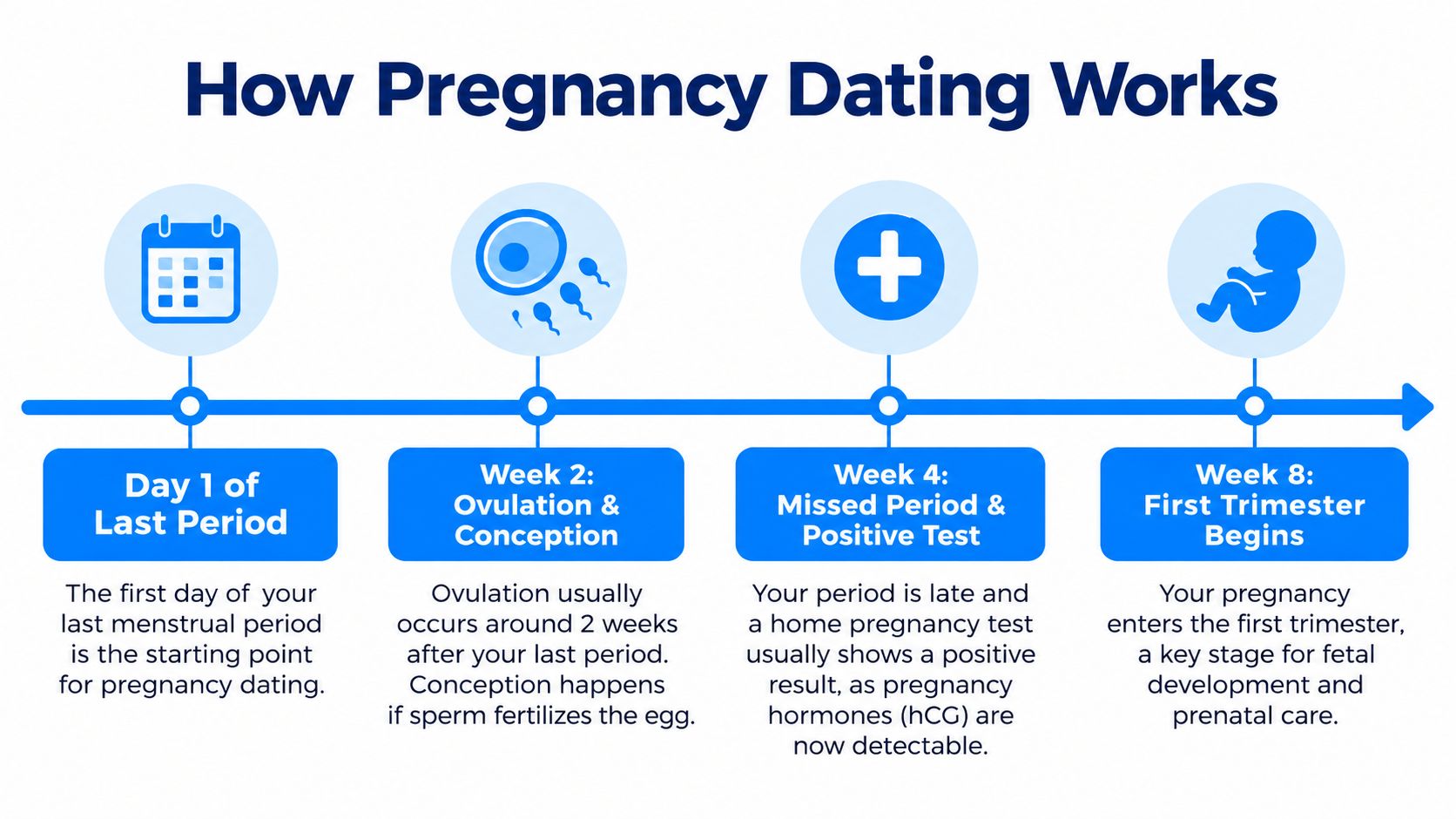
When someone says you are eight weeks pregnant, they mean eight weeks since the first day of your last menstrual period (LMP). That is not eight weeks since conception. Healthcare providers count pregnancy from the LMP because ovulation timing varies and the period start date is usually easier to recall. That is why the gestational week on an app or ultrasound report often sounds about two weeks ahead of how long the embryo has actually been developing.
A pregnancy week is a range, not a grade. Fetal milestones, symptoms, and body changes unfold across windows rather than on one exact day. Use the week number your provider gives you as orientation, not a pass-or-fail test.
The guide below walks through trimesters, dating, and common development milestones week by week. It is general information, not a substitute for your provider’s guidance.
What each trimester feels like
A positive test can make time behave strangely. At first, pregnancy may feel almost invisible. You might be tired before anyone else knows why, suddenly dislike a familiar smell, or feel unexpectedly moved by an ordinary grocery-store advertisement. Your body is already changing, while daily life may look much the same.
The middle months often bring a different rhythm. Energy may return, sharing the news can feel easier, and the first movements turn an abstract idea into a physical relationship. A flutter may resemble a bubble, twitch, or tiny tap. Identifying it can take time, and that uncertainty is normal.
The final stretch feels more physical. Sleep becomes a negotiation involving pillows, bathroom trips, and a body with strong opinions about comfortable positions. Pelvic pressure, practice contractions, and growing awareness of birth can make the calendar feel slow and fast at once.
Three broad chapters
-
Early pregnancy: Implantation, the neural tube, the heart, and major organ systems develop rapidly. Fatigue, nausea, breast tenderness, food aversions, and heightened emotions may arrive together.
-
The middle months: Movement, hearing, bone development, and visible body changes become easier to recognize. Appointments and scans can give the pregnancy a clearer shape, while a tracker helps connect those changes with the relevant week.
-
Late pregnancy: Growth continues alongside brain and nervous-system maturation, lung readiness, changing movement patterns, and preparation for life outside the uterus.
These chapters provide a map, not a rigid checklist. Symptoms can begin early, late, or not at all. Milestones may unfold across several weeks instead of appearing on one magical morning.
A useful mindset: Use weekly information to understand the direction of development, not to grade your pregnancy against someone else’s.
A tracker is most helpful when it places your experience beside fetal development and practical reminders. That connection explains why one week may focus on rest and symptom awareness, while another brings movement notes, appointment preparation, or birth planning.
How gestational weeks are counted from your LMP
The standard timeline uses 280 days from the LMP, which is why pregnancy guides usually run to about 40 weeks rather than 38 weeks from conception. The American College of Obstetricians and Gynecologists’ guidance on estimating the due date explains the clinical reasoning behind this convention.
Ovulation timing varies from person to person and cycle to cycle, which is one reason providers use a standardized gestational clock rather than trying to calculate every pregnancy from an uncertain conception date.
Reading the calendar in practical terms
Week four may arrive around the time of a missed period, which means the pregnancy can already be described as four weeks along before a home test confirms it. An early ultrasound may refine the estimated due date by comparing development and measurements with the expected gestational timeline. If that date changes, every later weekly milestone shifts with it.
Trimesters are useful orientation points, but they aren’t three identical boxes. The first trimester includes the embryonic period and the beginning of the fetal period. The second emphasizes growth, movement, and sensory development. The third focuses increasingly on maturation and preparation for birth.
For people trying to conceive, understanding the fertile window and ovulation timing can clarify why conception dates are estimates rather than guaranteed calendar events. For everyone else, the simplest rule is this: follow the gestational week your healthcare provider gives you, even if an app’s wording makes the timeline feel unusual.
First trimester: weeks 1 through 13
The first trimester is busy in a way that can be hard to see from the outside. The embryo moves from implantation toward the formation of the structures that will later support the brain, heart, limbs, and organs. Your body is also responding to major hormonal changes, which helps explain why fatigue and nausea can feel disproportionate to the pregnancy’s visible size.
Weeks one through three
Weeks one and two are usually counted before conception has occurred. Around week three, fertilization and implantation take place, although the exact timing varies. Some people notice nothing; others experience early changes that are easy to mistake for an ordinary cycle.
By week four, a missed period may prompt testing. During weeks four through six, the neural tube closes, the heart begins beating, and the earliest organ development accelerates. Nausea, breast tenderness, tiredness, food aversions, and sensitivity to smells often become more noticeable in this same window.
Weeks seven through ten
The embryo develops rapidly during weeks seven through ten. Fingers begin separating, limbs become more defined, and the nervous system and internal organs continue taking shape. Around week nine, the terminology changes from embryo to fetus, marking a shift from the earliest organ formation toward continued growth and differentiation.
The National Library of Medicine’s overview of embryonic and fetal development describes the embryonic stage as lasting from about the third week through the end of week eight. By the end of week eight, all organ systems have formed enough to continue maturing, and the fetal period begins around week nine.
Weeks eleven through thirteen
Weeks eleven through thirteen are a transition phase. External features become more recognizable, fingernails are sprouting by week 12, or 10 weeks after conception, and bones begin to harden around week 13. These changes show why the end of the first trimester isn’t just a calendar milestone. The baby’s body is moving from initial construction toward refinement.
Many people also notice that nausea eases or energy begins returning during this period, though not everyone gets that welcome reprieve. First-trimester screening and ultrasound timing varies by care plan, so your provider’s schedule matters more than an app’s generic reminder.
| First Trimester Development at a Glance | ||
|---|---|---|
| Weeks | Key Fetal Development | Common Symptoms |
| One to three | Fertilization, implantation, and early structural development | Few symptoms or subtle changes |
| Four to six | Neural tube closure, early heart development, rapid organ formation | Nausea, breast tenderness, fatigue, food aversions |
| Seven to ten | Limb and finger development, continued organ formation, embryo-to-fetus transition around week nine | Bloating, nausea, smell sensitivity, emotional changes |
| Eleven to thirteen | Fetal growth continues, fingernails sprout by week 12, bones begin hardening around week 13 | Energy may improve, nausea may ease, symptoms remain variable |
Symptoms aren’t random inconveniences. Hormonal and physical changes support the pregnancy, but severe or worrying symptoms deserve a conversation with your healthcare provider rather than a comparison with an online week guide.
Second trimester: weeks 14 through 27
The second trimester is often the reveal phase. Pregnancy may become visible, movement begins to feel more distinct, and scans can show how the baby’s anatomy is developing. The pregnant body changes too, as the uterus rises, the abdomen expands, and the early exhaustion may give way to a more usable supply of energy.
Weeks thirteen through seventeen
Around week 13, bones start to harden, especially in the skull and long bones. The baby continues developing facial features, vocal structures, and unique patterns such as fingerprints. Some people notice the first fluttering movements during this broad period, although first movement can be difficult to identify and doesn’t arrive on one universal schedule.
Around week 14, many pregnant people experience an energy rebound. That doesn’t mean every symptom vanishes. Round ligament aches may appear as the uterus grows, and skin changes such as a linea nigra can become more noticeable.
Weeks eighteen through twenty-two
The anatomy scan commonly falls within this general window, but the appointment schedule depends on your clinical care. Hearing develops, and movements may shift from uncertain flutters to stronger kicks. By 20 weeks, eyebrows and hair are visible, according to the Mayo Clinic’s fetal development timeline.
Those sensory milestones can create new bonding cues. Talking, singing, or noticing patterns in movement can make the pregnancy feel more reciprocal, even though the baby’s responses aren’t always predictable.
Weeks twenty-three through twenty-seven
The lungs branch and mature, sleep and wake patterns become more organized, and the baby continues practicing movements that support later coordination. Viability may enter conversations during this period, but it isn’t a single switch that turns on at one exact moment. Decisions about early delivery and newborn care are personal medical matters for the pregnant person and care team.
| Second Trimester at a Glance | ||
|---|---|---|
| Week Group | Fetal Milestone | Maternal Change |
| Thirteen to seventeen | Bones harden, fingerprints and vocal structures develop, early movement may begin | Energy may return, uterus rises, round ligament aches or skin changes may appear |
| Eighteen to twenty-two | Hearing develops, kicks strengthen, eyebrows and hair are visible by week 20 | Belly growth becomes more apparent, anatomy-focused care may occur |
| Twenty-three to twenty-seven | Lung branching, sleep-wake organization, and continued sensory maturation | Movement feels more familiar, physical stretching and pressure increase |
Tracking movement can be enjoyable, but it shouldn’t become a test you feel compelled to pass. Your provider can explain what patterns matter for your individual pregnancy and when to call.
Third trimester: weeks 28 through 40
The third trimester is preparation, not an empty waiting room. From week 28 onward, the baby gains weight, the brain and nervous system mature, the lungs continue preparing for breathing, and the body gradually moves toward birth readiness. The Mayo Clinic’s later-pregnancy development reference notes that the brain and nervous system become fully developed during weeks 30 through 36 while weight gain becomes faster.
At 28 weeks, eyelids can partially open. Around 29 weeks, kicking and stretching become more apparent, and by 33 weeks pupils can respond to light, as described in the Mayo Clinic’s third-trimester guide. Later in the trimester, the fetus also practices breathing in amniotic fluid.
Growth and positioning
Between roughly weeks 30 and 34, many babies move toward a head-down position, though timing and position vary. Fat accumulates under the skin, the brain develops more complex folds, and the lungs continue maturing. These changes pair with familiar maternal sensations, including Braxton Hicks contractions, pelvic pressure, frequent urination, and disrupted sleep.
A tracker can make this phase more practical. Log symptoms in a way you can show your provider, keep appointment reminders visible, and prepare questions while they’re fresh rather than trusting a tired late-night memory.
Full term isn’t the same as an exact birthday
A fetus is considered near term by week 37, while a healthy pregnancy is generally advised to continue until at least week 39 before delivery when there isn’t a medical reason for earlier birth. The 40-week due date remains an estimate, not a biologic cutoff. Labor can begin before or after it, so the Cleveland Clinic’s fetal development stages emphasize watching for labor signs rather than expecting birth on one precise day.
By weeks 38 through 40, average length is near 18 to 20 inches and weight is around 6 to 9 pounds, with the fetus considered fully developed or full term and ready for birth. Use those broad ranges as context, not a prediction for your baby.
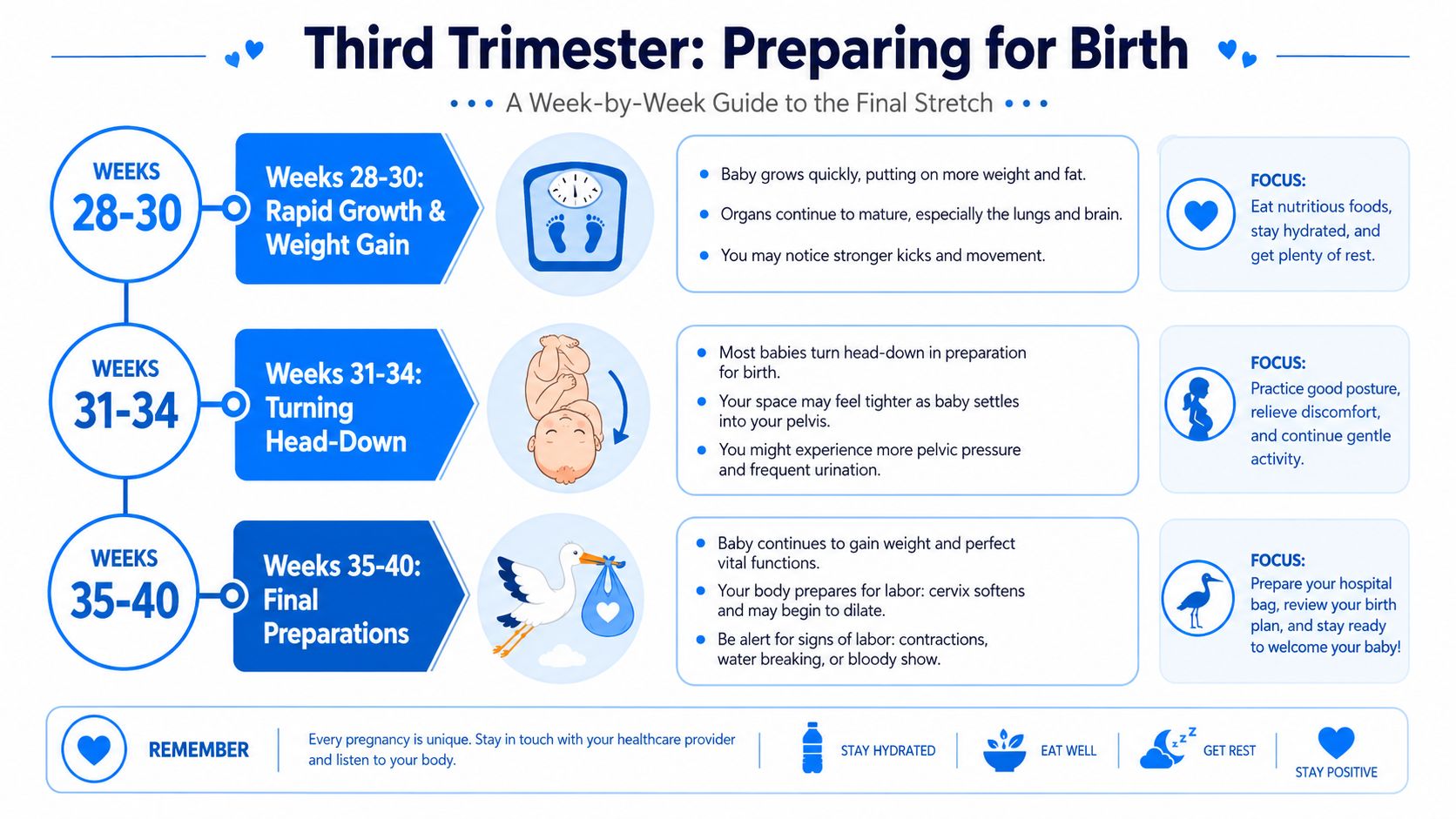
Preparation becomes more useful when tied to a body change: pelvic pressure can prompt a hospital-route conversation, poor sleep can justify simplifying your schedule, and changing movement patterns can prompt a call to your provider.
This short visual offers another way to review the late-pregnancy sequence:
Private pregnancy tracking on your iPhone
At first, you may open an app to record nausea and questions for your next appointment. Later, the same tool may help you note movement or time contractions. A useful pregnancy tracker follows these changing needs without turning each week into another list of demands. It should connect maternal changes, fetal milestones, and practical reminders, so the timeline feels understandable rather than like a set of disconnected size comparisons.
A guide to choosing a pregnancy tracker worth using can help you compare features before committing.
Match features to the stage
A sensible tracker includes:
-
Symptom journaling: Record nausea, pain, mood, energy, sleep, and appointment questions. Add context, such as when a symptom began or what affected it, instead of leaving a vague “bad day.”
-
Appointment reminders: Keep scans, checkups, tests, and questions together. One organized record is easier to review than details scattered across a calendar and several message threads.
-
Kick counting: From around week 28, a kick counter may help you record movement consistently if your provider recommends it. Your care team should explain the expected pattern and method.
-
Contraction timing: A timer can record frequency and duration when contractions become relevant. It cannot diagnose labor or replace medical advice.
-
Weight and blood pressure logs: These records can make appointment discussions clearer, but home readings require clinical interpretation, especially alongside concerning symptoms.
Practical rule: A tracker should support communication with your provider. It should never persuade you to dismiss a change because an app labels it typical.
Check the app before trusting it
Read the weekly content closely. It should identify medical review clearly, avoid dramatic promises, and explain that development varies. Due-date calculations deserve particular attention because the gestational timeline may be refined after clinical assessment. Look for settings that accommodate multiple pregnancies, different care plans, and people who prefer fewer notifications.
Privacy belongs in the same review. An app that stores reproductive health details on the device, works offline, avoids advertising and analytics, and offers an optional Face ID lock limits where intimate information travels. Remote syncing can be convenient, while local storage may suit someone who wants a private record. For a side-by-side look at how major trackers handle accounts, sync, and advertising, see private period tracker apps. If you are weighing a switch from a cloud-based app, switching from Flo walks through what changes when logs stay on your device.
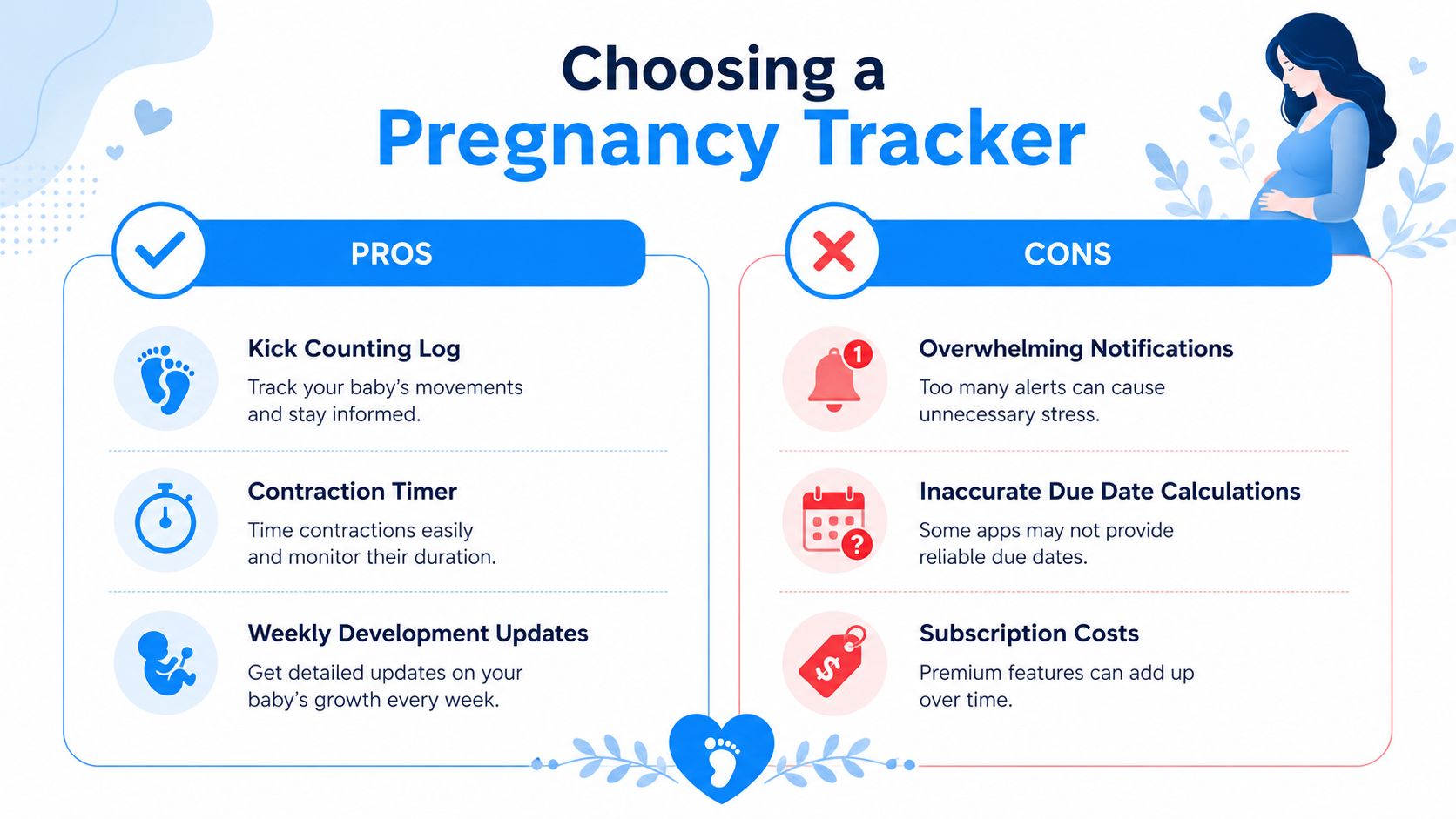
Standalone pregnancy trackers suit people who want a focused weekly view and a few practical tools. All-in-one apps fit people who want cycle, fertility, contraception, symptom, and pregnancy records together in one timeline. See Lua’s period tracker and pregnancy tracker for how those modes connect. Before choosing either type, review its privacy policy, notification controls, clinical review process, export options, and whether it works without an account.
Common questions
Does a missed milestone mean something is wrong? Usually, a weekly guide describes a range of development rather than a single appointment-day event. Babies and pregnancies don’t follow identical schedules, and an app cannot interpret an ultrasound, examination, or symptom pattern. Bring a concern to your provider instead of trying to solve it through comparison.
When should movement feel regular? Early movement may be subtle and inconsistent. Later, your provider may ask you to pay attention to your baby’s usual pattern. A noticeable change in movement deserves a call, even if a tracker still displays a reassuring general milestone.
What about contractions before week 37? Braxton Hicks contractions can occur during late pregnancy, but contractions that are painful, regular, increasing, or accompanied by fluid leakage, bleeding, or other concerning symptoms need prompt medical guidance. Don’t use a timer as a substitute for contacting your care team.
Why did my due date move? The due date is an estimate based on a standardized gestational clock and may be refined after clinical assessment. A changed date shifts the week labels attached to later milestones, but it doesn’t mean development has suddenly gone backward.
A weekly checklist
Early pregnancy
-
Prepare for care: Arrange prenatal care and keep a running list of symptoms and questions.
-
Support your routine: Take prescribed or recommended supplements as directed by your provider, and make food, rest, and hydration easier where you can.
-
Record changes: Note nausea, fatigue, breast tenderness, food aversions, mood, and anything that worries you.
Middle pregnancy
-
Attend planned appointments: Keep scans and checkups on your calendar, and ask what each appointment is intended to assess.
-
Notice movement: Learn your baby’s emerging pattern without demanding perfect consistency too early.
-
Adapt comfortably: Use supportive clothing, rest breaks, and gentle movement according to your care team’s advice.
Late pregnancy
-
Track movement when advised: Kick counting may begin around week 28, using the method your provider gives you.
-
Time contractions if needed: Record frequency and duration, then contact your provider when symptoms meet their guidance.
-
Pack by week 36: Prepare a hospital bag, confirm transport, and keep essential contact details accessible.
-
Call for warning signs: Contact your provider about bleeding, fluid leakage, severe pain, troubling symptoms, or a clear change in movement pattern.
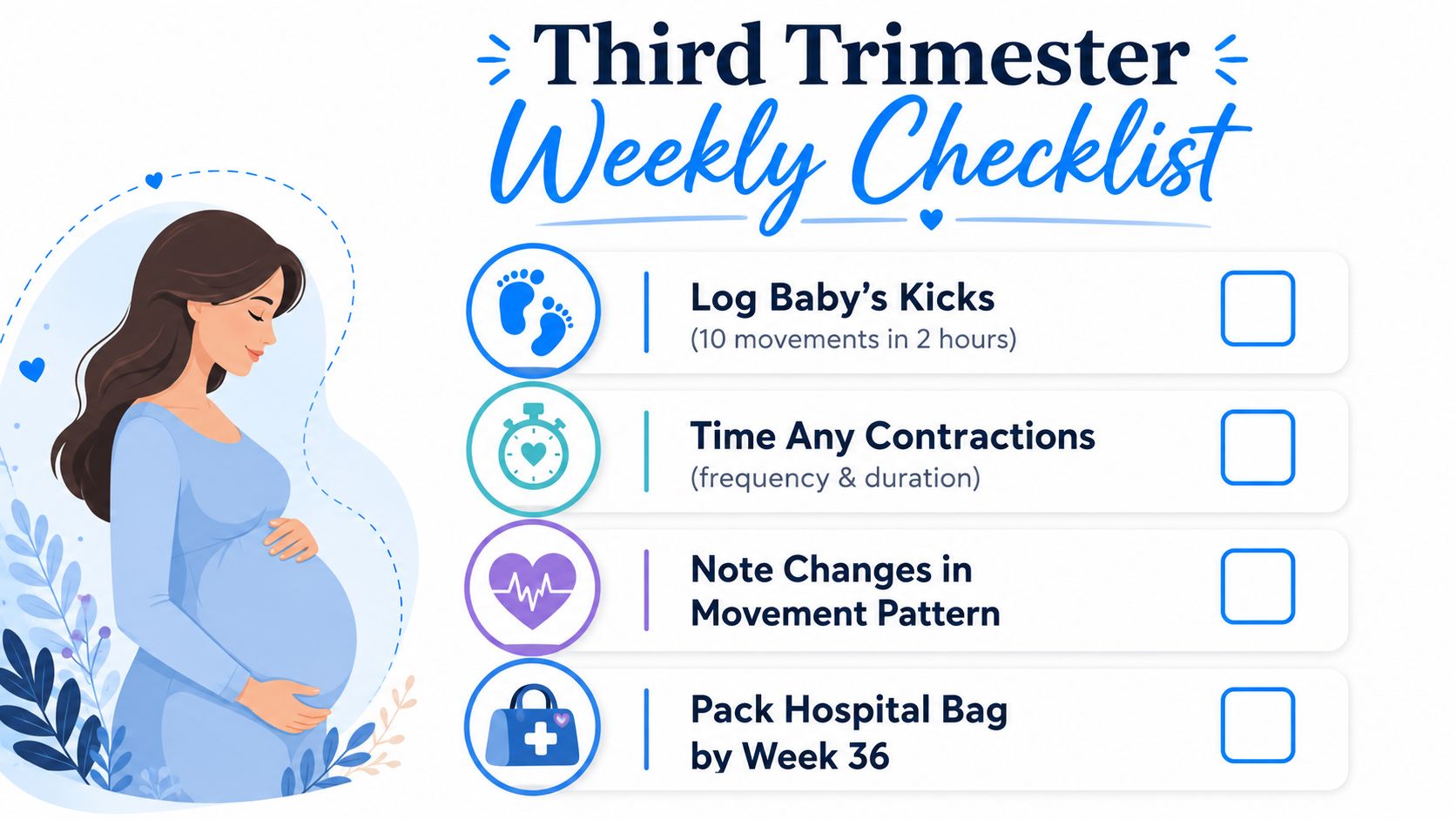
Save this checklist in your notes or tracker, then personalize it with the instructions from your own care team. The most useful pregnancy timeline is the one that helps you recognize change, ask better questions, and feel less alone in the uncertainty.
Lua brings cycle, fertility, symptom, and pregnancy tracking into one private timeline, with week-by-week pregnancy updates, kick counting, contraction timing, configurable reminders, and on-device storage. Visit Lua to explore a pregnancy tracker designed to keep reproductive health details on your device while helping you stay oriented through each stage.
Lua is not a contraceptive; this is general information, not medical advice. Follow your provider.
More from the blog
One app for your cycle, contraception, fertility and pregnancy.
Private, flexible and designed to adapt with you.