

How to Put In and Take Out a Vaginal Ring
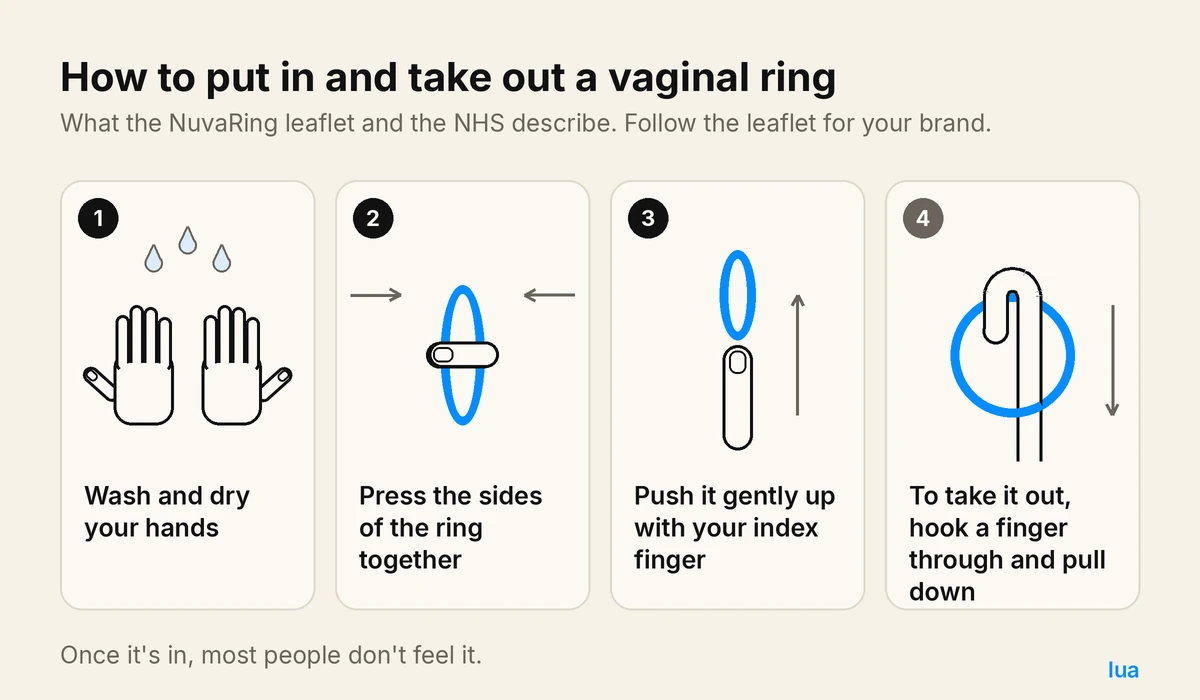
To put in a vaginal ring, you wash your hands, squeeze the ring between your thumb and index finger, and push it gently up into your vagina with a finger. To take it out, you hook a finger through the ring and pull it gently down and out. The NHS compares putting it in to inserting a tampon, and once it’s in place you usually shouldn’t feel it.
The steps below come from the NuvaRing Patient Information and Instructions for Use published by the manufacturer, Organon, and from the NHS page on using the vaginal ring. They’re a summary of what those sources say, not our own instructions. If you use a different brand, the leaflet in your box is the one to follow, and the NHS points out that it includes pictures of how to put the ring in and take it out.
How to put in a vaginal ring: what the leaflet says
The NuvaRing Instructions for Use break insertion into four steps:
- Choose a position. Pick whatever is comfortable, for example lying down, squatting, or standing with one leg up.
- Open the pouch. Wash and dry your hands first. Open the foil pouch at either notch near the top, and keep the pouch, because you’ll put the used ring back in it later.
- Prepare the ring. Hold it between your thumb and index finger and press the sides together.
- Insert it. Put the folded ring into your vagina and gently push it further up with your index finger.
The leaflet adds a few reassurances. The ring doesn’t have to sit in an exact position to work. It may move around slightly, which is normal. Some people are aware of it, but most don’t feel it once it’s in place. The NHS says the same: once the ring is in, you shouldn’t be able to feel it, including during sex.
The leaflet also asks you to check regularly that the ring is still in your vagina, for example before and after sex. It lists sex, bowel movements, tampon use and breakage as ways a ring can slip out.
How to take out a vaginal ring: what the leaflet says
Removal is two steps in the NuvaRing Instructions for Use:
- Remove it. Wash and dry your hands and choose a comfortable position. Put your index finger into your vagina, hook it through the ring, and gently pull downward and forward to bring it out.
- Throw it away. Put the used ring back in its re-sealable foil pouch and put it in the trash, out of reach of children and pets. Don’t flush it down the toilet. The NHS gives the same instruction: pouch, then bin, never the toilet.
Then comes the 7-day break before the next ring goes in.
When to put it in and take it out
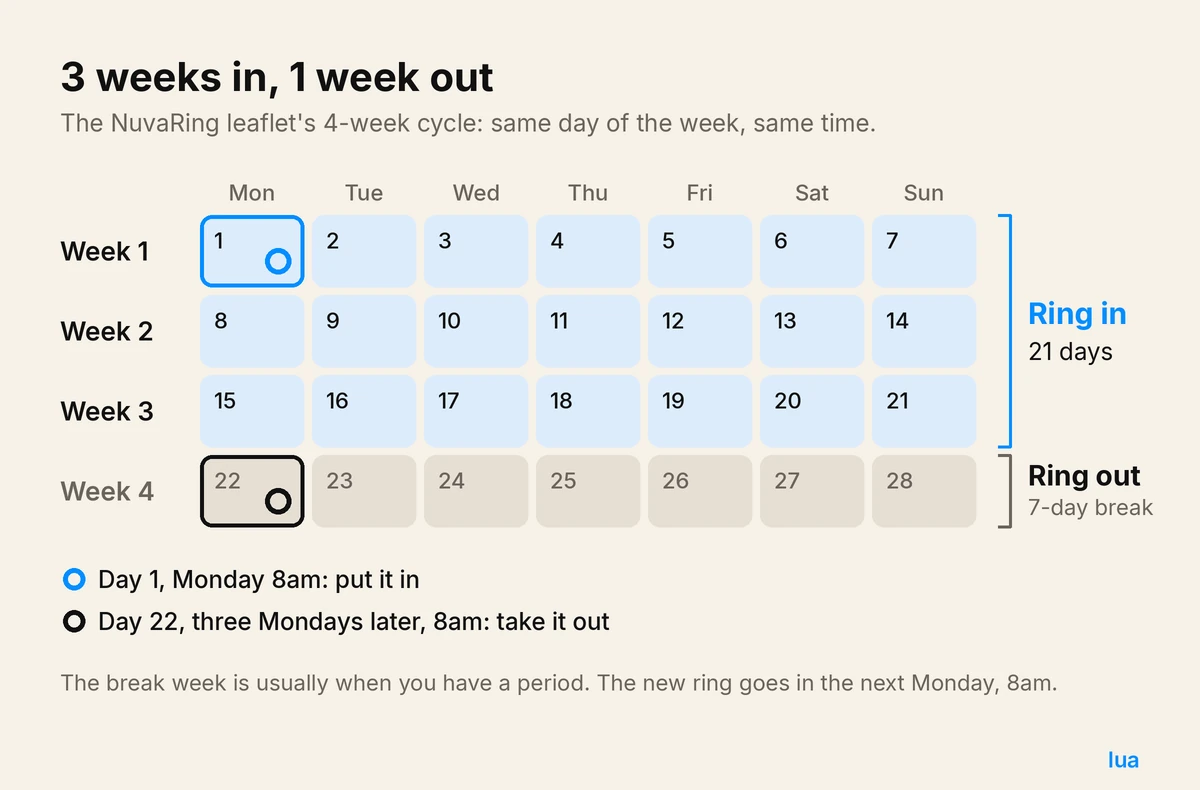
According to the NuvaRing leaflet, the ring is used in a 4-week cycle. You keep one ring in for 3 weeks (21 days), then take it out for a 1-week (7-day) break, when you’ll usually have a period. The leaflet asks you to insert and remove it on the same day of the week and at the same time. Its example: put it in on a Monday at 8am, take it out three Mondays later at 8am, and put a new ring in the following Monday at 8am. If you want help keeping those dates straight, see vaginal ring schedule tracking.
On a day-by-day calendar, the ring stays in for days 1 through 21, comes out on day 22, and a new ring goes in after the seven-day break.
When it doesn’t feel right
This table points to what the NuvaRing leaflet says for common situations. It’s not a substitute for reading that section yourself, and if your situation isn’t covered, the NHS suggests speaking to a pharmacist, nurse or doctor.
| Situation | What the leaflet says |
|---|---|
| It’s uncomfortable, or you can feel it | You may not have pushed it in far enough. Gently push it as far as you can with your finger. The leaflet says there’s no danger of pushing it too far or losing it |
| It seems to have moved | Moving slightly is normal, and it doesn’t need an exact position to work |
| Pain during or after insertion, and you can’t find the ring in your vagina | Call your healthcare provider right away. Some people have accidentally inserted it into the bladder |
| You can’t get it out | There have been reports of rings sticking to vaginal tissue. Call your healthcare provider if you can’t remove it |
| It came out and has been out for less than 3 hours | Rinse it in cool to lukewarm (not hot) water and put it back in right away |
| It has been out for more than 3 hours, or you don’t know how long | The leaflet’s instructions depend on which week you’re in and may include backup contraception or a pregnancy test. Read that section carefully. Our post on when a vaginal ring comes out early covers keeping track of the dates |
| It came out with a tampon | Rinse it in cool to lukewarm water and reinsert it right away. The leaflet suggests putting the ring in before the tampon, and taking care when you remove a tampon |
| It broke | If a broken ring stays in your vagina, the leaflet says this shouldn’t lower its effectiveness. If it breaks and slips out, throw it away and insert a new one |
A few other things the sources mention
- Tampons are fine. The leaflet says using tampons won’t make NuvaRing less effective.
- One ring at a time. The leaflet says not to use more than one ring at once.
- Left in too long. Up to 4 weeks (28 days) in, the leaflet says you’re still protected; take it out for a week, then insert a new one. Beyond 28 days, it tells you to remove it and check you’re not pregnant before starting again, with backup contraception for the first 7 days of the new ring.
- Starting for the first time. The NHS says that if you’re not already using hormonal contraception, you can usually start from day 1 to day 5 of your period. The NuvaRing leaflet is a little stricter: it says to use a barrier method for the first 7 days if you start on days 2 to 5. Follow the leaflet for your brand, and if you’re switching from another hormonal method, the NHS suggests talking to a doctor or nurse first.
- How well it works. The NHS says the ring is more than 99% effective when used correctly all the time, and about 91% with typical use, because things like forgetting to replace a ring on time happen.
- Some medicines interfere. Both sources list medicines and herbal remedies, including St John’s wort and some epilepsy, TB and HIV medicines, that can make the ring less effective. Ask a doctor or pharmacist if you take any of them.
When to get help
Call your healthcare provider right away if you have pain during or after insertion and can’t find the ring, or if you can’t get it out, as the leaflet advises. The NuvaRing leaflet also lists warning signs that need urgent attention, including leg pain that doesn’t go away, sudden shortness of breath, severe chest pain or pressure, a sudden severe headache unlike your usual ones, and weakness or numbness in an arm or leg. It’s worth reading that section in full.
Keep your cycle in one place
If you use a ring, it helps to know when your bleeds actually come. You can log your cycle in Lua: Period & Birth Control, and it estimates your next period from what you’ve logged, with your logs kept on your iPhone. With Lua+ you can also turn on ring reminders for the days your ring goes in and comes out. Your ring and its leaflet do the contraception. Lua just keeps track of the dates.
Sources
- Organon. NuvaRing (etonogestrel/ethinyl estradiol vaginal ring) Patient Information and Instructions for Use. Revised December 2024.
- NHS. How to use the vaginal ring.
More from the blog
One app for your cycle, contraception, fertility and pregnancy.
Private, flexible and designed to adapt with you.